Peer Support and Me
– 10 min read
Something brilliant happens when a person with mental health challenges, who has spent a lot of time fearing or hearing that they are different, inadequate, or a problem, discovers that all their exact life experiences – the inner struggles they work hard to overcome and to live with – are not only normal, perfectly understandable and deserving of recognition, but also give them the power (we would argue, the ‘super-power’) to help somebody else, just by being there and being themselves.
It sounds too good to be true, but having been helped by peer support myself, studied peer support, participated in the Scottish Recovery Network’s (SRN) pilot online Peer2Peer course, and started putting it into practise, I can assure you that it’s real, and it works.
At first, I was sceptical when I heard the name, peer support, because it reminded me of ‘peer pressure’ or being ‘judged by a jury of your peers’ but in this instance, the word peer has only positive connotations.
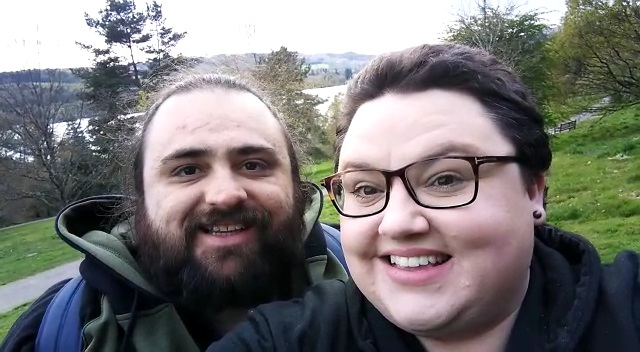
I didn’t realise, before I came into contact with SRN through my local mental health charity, Stepping Stones, that most of us are a source of some kind of informal peer support for another person without even knowing it. My boyfriend, who also has mental health challenges, is a peer (as opposed to a mental health professional) and he provides me with invaluable support, because he understands how it feels at times.
Depending on the situation, anybody in our lives can offer us peer support in the form of real listening, empathy, sharing and encouragement.
Peer support is not a new concept; in my opinion, it's a new way of describing and grouping together some pretty important 'doing words' that humans were always capable of, if not good at.
Listening to understand rather than just to answer, is not new. Empathy and encouragement are not new. Sharing of stories is not new, but what is new or feels new about peer support, is the way that these apparently simple things are valued, harnessed and employed to great effect in the course of mental health recovery.
More formal peer support came into my life in Spring 2018, when I was thirty-four and had just quit my job because, despite my life appearing quite rosy on the surface, my anxiety and depression were spiralling out of control, to the point where I frequently had a strong desire to kill myself, and that was terrifying.
I didn’t really want to die, but whenever I went over things in my head, it all seemed absolutely impossible to deal with and I was convinced that I was worthless, I could never change, and that it was pointless to try.
Maybe the best way I’ve found to describe that feeling was, like my own mind was hell-bent on ruining my life and all I could do was watch. So, I just wanted it to stop forever, because it was unbelievably painful to watch how my life was going and think how different it could have been if certain things had never happened.
That’s horrible for me to see written down in black and white, but, in my opinion, the subject of suicide and suicidal thoughts is still quite misunderstood by people who’ve never experienced it, so I think it’s important to be as honest as we feel able to be, as often as we can be, and to get comfortable with being uncomfortable discussing such difficult subjects.
We might all be surprised at how common it is to feel that kind of despair and mental anguish, to feel like it’s genuinely the end of the world, but at the same time to believe that it’s not important enough, that you’re not worth enough to ask for help, or how common it is to be that brave soul who does manage to reach out for help, only to be told no, you can’t get it, you don’t need it, you’re wrong. I don’t believe you.
Fortunately, I did reach out and I did get the help that, I realised, I had needed for a long time.
After years of taking anti-depressants and putting off my doctor’s advice to try counselling, to deal with the trauma and unhelpful thoughts underlying my mental health problems, I finally plucked up the courage to phone and make an appointment. I didn’t want to talk to a ‘stranger’ about my problems, but I felt I had no choice and nothing to lose by this point.
My wonderful cognitive behavioural therapist, a professional whose methods have changed my life, was able to draw on her own lived experience to a certain extent, to illustrate what she was teaching, and to reassure me.
A lot of people choose a mental health profession because they have that experience themselves but, depending on their job, it’s not always possible for them to share these experiences with the people they help. This is where I think peer support and professional support can often work hand in hand.
When I had my initial assessment meeting, a local weekly social group was also presented as an option, and I jumped at the chance.
There was a waiting list for CBT, understandably due to high demand, but I made it clear that “now I’ve made it through the door, I’m determined to do something ASAP”!
Later that same week, thanks to Stepping Stones, I was sitting in the group – and here I am, still attending regularly three years later, currently via Zoom of course. My gratitude for that group is something I struggle to put into words, but I’ll try.
We’re not a ‘self-help’ group (not that there’s anything wrong with that) and we don’t always discuss our problems.
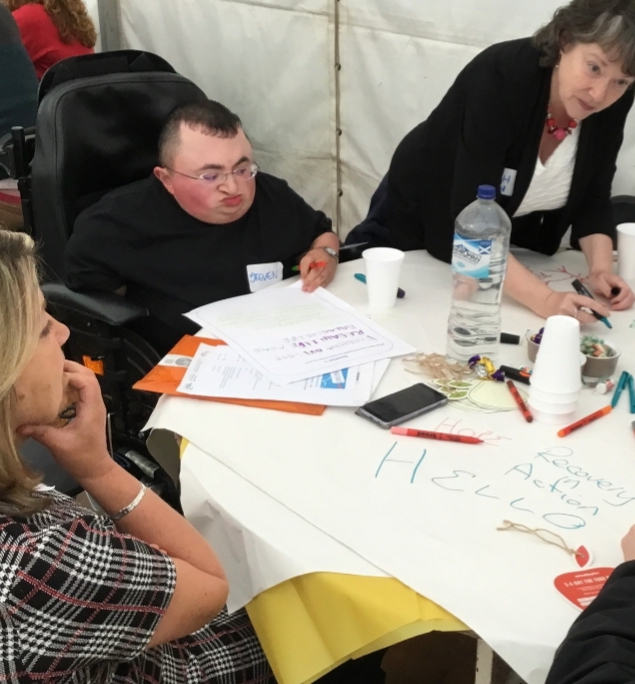
These groups are set up differently. We just chat, about anything and everything, keep our minds busy with activities or de-stress with some relaxation techniques and we always have a laugh – over a cuppa or two! I think we share an unspoken camaraderie.
There’s no pressure to share details of your mental health, but we all know that everyone in the room has faced similar challenges.
When I go along (or ‘Zoom In’) to my group I know that, no matter how bad a week I’ve had, this is a supportive space where I can be myself, and if I do need to get something off my chest, my peers and facilitators are there for me, unconditionally and free of judgement. ‘Real life’ isn’t like that, but it should be, and it will be, when more people come to understand that peer support is in all of us.
In this group of ordinary (yet extraordinary!) people, we have learned to accept that we all handle our moods differently… some go quiet, others get loud, some cry, others get angry… and that’s OK.
Maybe the most important thing about this group for me, is that it reminds me that, even when I am really struggling, I can still have fun, I can still have meaningful conversations and I can still help others like they are helping me, but I don’t have to hide anything or ‘act normal’.
Even our amazing group co-ordinator and peer worker have their ‘bad’ days, but they will share that with us, which is so empowering. They are showing us that yes, it is essential to talk about mental health, but it doesn’t have to be what defines us.
Within Stepping Stones we also have a small peer study group and during lockdown we have been reading through the SRN Peer2Peer resource book, one chapter at a time, and discussing it together.
In 2019, we got to know each other while planning ‘The Big Chat’ – a local mental health conversation café event – but I think, had the staff of SRN, Stepping Stones and the various other local organisations who got involved, not treated us ‘peers’ (i.e. service users living with mental health challenges) as equals in the decision making and running of this event, we might not be where we are today. We all agree that ‘The Big Chat’ was a turning point for us because it gave us responsibility, a sense that our opinions matter, and it meant that we always had things to talk about!
We became an informal peer support group independently of Stepping Stones, and we meet for lunch or coffee when possible, though, during lockdown our meetings have mostly taken the form of Zoom quizzes (sometimes in fancy dress, just for fun!) or just regular catch-up calls out with our Stepping Stones peer study group and social groups.
My boyfriend was able to meet my peer friends via Zoom and then in real life when the restrictions were eased last year, and I am so glad we’ve had this mental and emotional support during the Covid-19 pandemic. It goes without saying that 2020 was a disastrous year for our collective mental health. Peer support has been a ‘safety-net’ for me and many others.
In February of last year, I decided it was time to start running my Facebook group, ‘Face The Day – with Emily’, where I’ve shared a lot of my experience with mental health and my ongoing ‘journey' and encouraged others to share, by posting relevant content and starting various talking points.
Little did I know at that time, what the virus would become and how important my group would be for the participants.
Now that I am moving away from social media (for many reasons), I plan to continue ‘Face the Day’ as a monthly email newsletter with associated YouTube content and Zoom chats. I’ve noticed, over the course of the year, that at least six group members have contacted me privately for informal peer support, so I feel like I must be on the right track.
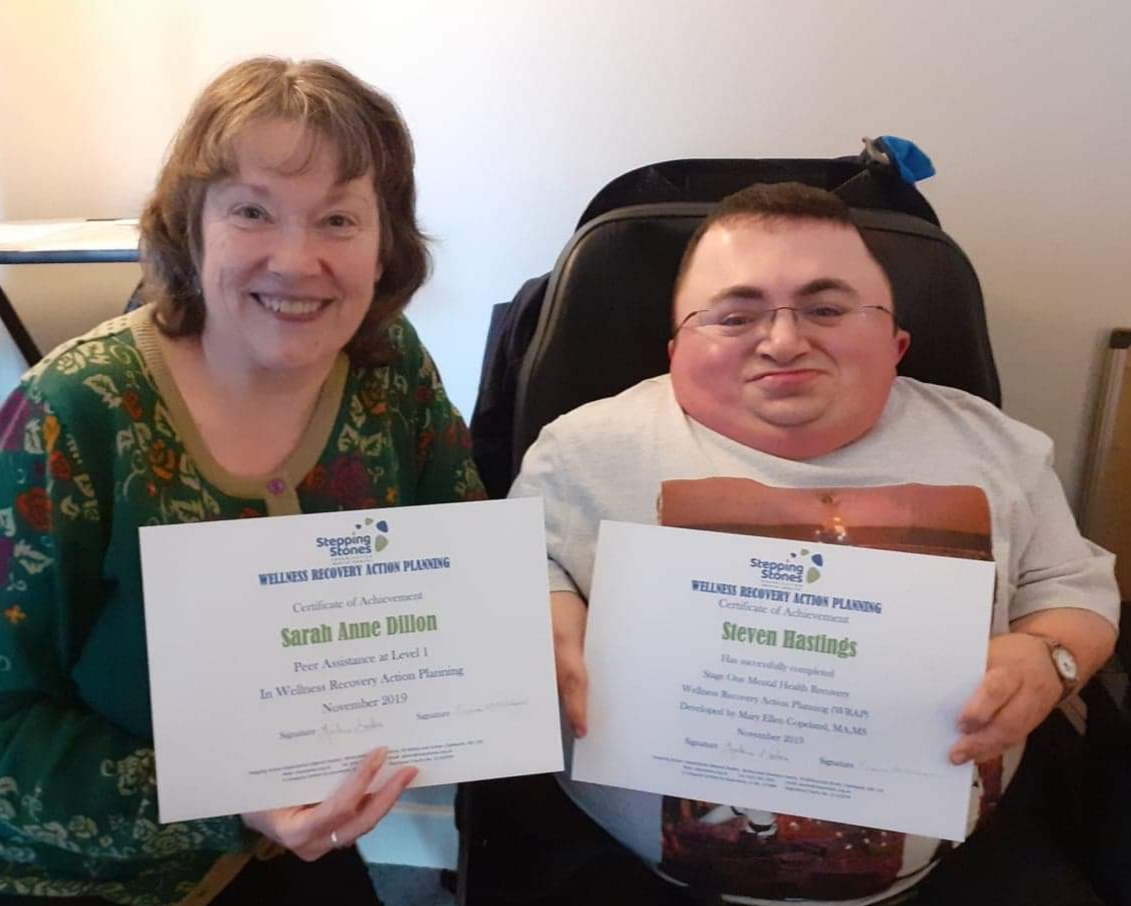
When I found out through Stepping Stones that SRN were running a pilot six-week online course on the Peer2Peer training, I couldn’t not apply!
This seemed like a perfect next step for me on my recovery and peer learning path, not only to flesh out my reading on some of the key training concepts like boundaries, trauma behaviours and re-framing negative experiences, but also to hone my listening and relating skills with practical exercises, to expand my understanding of what recovery and peer support looks like for other people and to gain confidence in building new peer support relationships, especially the more formal type that I might encounter when volunteering or working as a peer supporter in the future. I also realised that I wanted to use the online course to develop the ability to teach or facilitate this Peer2Peer training, because I could see its potential.
I soon discovered that this was more than a run-of-the-mill training course to learn a set of skills, it was immersive self-development.
Much of my own experience, thoughts and feelings have been validated, just by being part of this new group of sensitive, diligent and thoughtful peers I met on the course, and I include the facilitators in that, because they gave so much of themselves.
I feel like a weight has been lifted off me, almost like, by spending time interacting with those inspiring people, the weight of a life’s worth of judgement and self-doubt has been eased, and I feel so much better about where I am in life and what I’m doing.
It was an incredibly fortifying and uplifting six weeks to have just before lockdown Christmas and New Year.
Peer2Peer has made me a more conscious, effective, confident peer supporter for my family and friends, and in my current peer groups, and I plan to use what I’ve learned at SRN to help my Stepping Stones Peer2Peer study group.
We are just about finished reading the materials and it would be good to be able to go back and do some practical exercises. This may be more challenging remotely, but the SRN pilot course has given me inspiration as to how we could go about it.
I am also offering my skills to Stepping Stones, either as a peer supporter for new people referring who are on the waiting list for counselling, or as a facilitator to other members of the organisation who want to learn more about the Peer2Peer resources created by SRN.
I am indebted to both of these charities and determined to pay it forward by giving others the same gift I have been given.
The discovery that, because of, not despite mental health problems, we are capable of so much, and that by learning how best to talk about mental health and support each other, without compromising our own boundaries or self-care, we become so powerful!
In some ways, peer support feels like the opposite of competition (with others, with the world, or with your own mind), rather, it is a loving acceptance of everything just as it is (which is much harder than it looks!), a comforting vulnerability (which sounds like a contradiction, but it’s not!) and the knowledge and hope provided by your peers, that you are not inferior, you can live a meaningful life, and you are not alone.
I think this ethos would benefit many areas, not just mental health. We all know that humans, like a lot of other species here on the Earth, can overcome challenges most successfully when working as a team, but even the concept of teamwork is toxic in certain settings. (If you are now having flashbacks of the phrase “There’s No ‘I’ in TEAM” on a corporate ‘motivational’ poster in some office canteen or toilet cubicle somewhere, I apologise!)
Teamwork can and frequently does “make the dream work”, but it also covers a multitude of sins.
I feel that, if all teamwork happened in the same way as we do peer support work, not by sacrificing the individual ‘I’ for super-productive yet inwardly dysfunctional homogenous entities, but by actively seeking and embracing the different experiences, strengths, and so-called weaknesses in any group of people, learning to relate to each other rather than judge each other, and figuring out how to flourish together – leaving no-one behind – THEN human teamwork could really become what it was meant to be.
I believe that we are capable of this, and society can and will evolve towards it, but that’s another story. Peer support is not reinventing the wheel – it feels more like remembering the importance of walking.